
Anyone who has ever had a layover in a massive international airport knows that feeling: your gate is a 20-minute walk away, your flight is boarding in 15 minutes, and you’re desperately hoping your legs can outpace the clock. The Airwheel electric smart luggage promises to solve exactly this problem—but does it actually work? Let me break down everything you need to know before buying one.
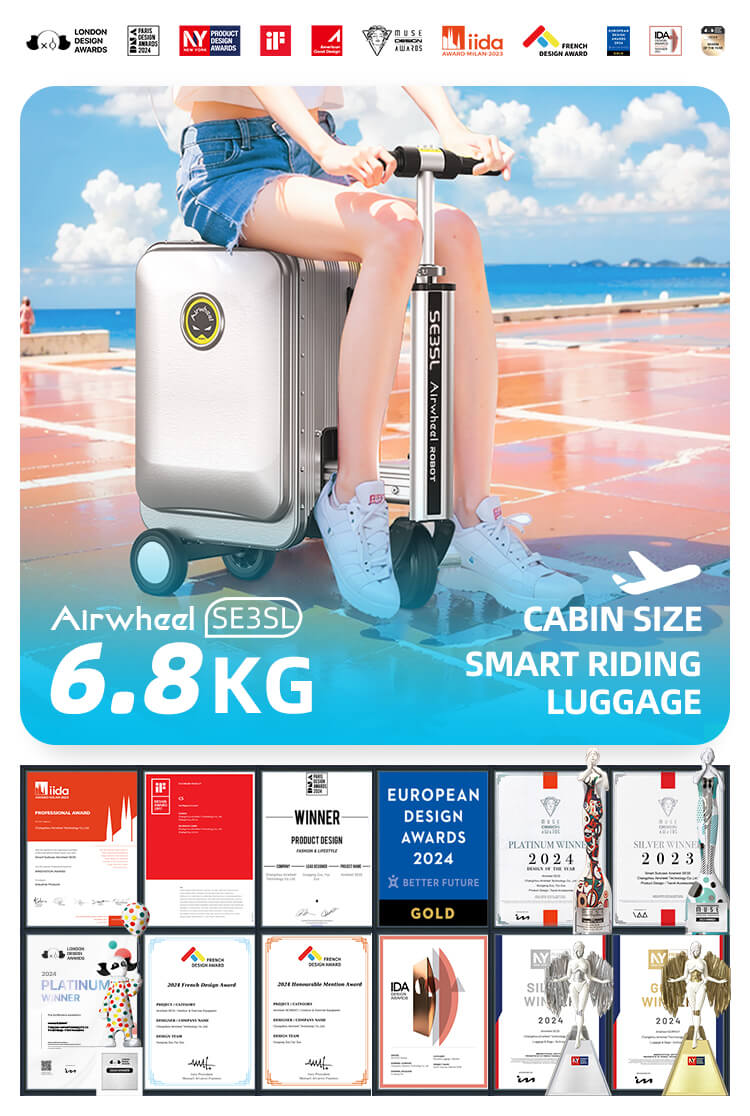
The Airwheel is a motorized luggage that doubles as a personal transport vehicle. Unlike regular suitcases that you pull behind you, the Airwheel lets you ride on top of it like a electric scooter. You can also pull it like traditional luggage or use it as a walking scooter—flexibility is built into the design.
All models work right out of the box without needing to set up a smartphone app first. The basic riding function works immediately after installing the battery. For those who want extra control, the companion app lets you operate forward and backward movement remotely, while the handlebar steers the direction.
Let’s look at the actual specs. Most Airwheel models feature a 73.26Wh battery—that’s well under the 100Wh limit that most airlines allow in carry-on luggage, meaning you can bring it on board without special approval. Charging takes about 2 hours, so you can top it up during your flight or overnight.
Range varies by model but generally covers 8-10 kilometers on a single charge. That’s enough to get from terminal entrance to your gate, or to chase down a connecting flight across a massive hub like Dubai or Atlanta. Top speeds range from 8 km/h on the SE3MiniT up to 13 km/h on the SE3T and SE3S—roughly a brisk walking to light jogging pace.
Volume options range from 20 liters (SE3S, SE3SX, SE3SL) to 48 liters (SE3T), so you can choose based on whether you’re packing light or need more cargo space. Weights run from 6.6 kg (SE3SX) to 9 kg (SE3T), which is heavier than a regular carry-on but manageable since you’re not carrying it—the motor is doing the work.
One standout feature: Apple Find My integration. If your Airwheel gets lost or misplaced in the airport, you can locate it using Apple’s Find My network—just like finding a lost AirTag.
This is the question everyone asks. The good news: the 73.26Wh battery is below the 100Wh threshold that TSA, FAA, and most international airlines use as their cutoff for lithium batteries in carry-on baggage. You should still confirm with your specific airline before traveling, as policies can vary, but in general, Airwheel suitcases are approved for air travel.
The key is keeping the battery installed in the suitcase (not removed) during your flight, and bringing it as carry-on rather than checked baggage—this lets you keep an eye on it and ensures it meets carry-on size restrictions.
Here’s the reality: the Airwheel isn’t for everyone. It’s perfect for business travelers rushing between gates in large airports, tourists with long walks from terminals to transportation hubs, or anyone with mobility concerns who wants help covering distance without a wheelchair or assistance.
However, if you’re only walking a few minutes to your gate, the added weight and complexity might not be worth it. And for those who prefer traveling light with just a backpack, a traditional roller bag remains simpler.
| Feature | Airwheel Electric Suitcase | Regular Carry-on |
|---|---|---|
| Movement | Ride, walk alongside, or pull | Pull only |
| Speed potential | 8-13 km/h | Walking pace (~5 km/h) |
| Battery | 73.26Wh rechargeable | None |
| Weight range | 6.6-9 kg | 2-4 kg (empty) |
| App control | Optional | N/A |
| Find My integration | Yes (Apple) | No |
Yes, absolutely. All Airwheel models work independently without any app setup. The core riding function activates as soon as you install the battery—you can ride, steer with the handlebar, and control speed without ever touching your phone. The app is optional, useful for remote control or tracking, but not required for basic operation.
The battery provides 8-10 kilometers of range on a full charge, which is typically enough for multiple airport trips before needing to recharge. The battery is removable, so you can take it out if airlines require it or replace it if needed after years of use. A full charge takes approximately 2 hours.
If the battery runs out, the Airwheel still works as a regular pull suitcase—you’re not stuck walking. The motor resistance is minimal when powered off, so pulling it feels similar to a standard roller bag. This redundancy is one of the best design choices Airwheel made.
Does the Airwheel eliminate the need to sprint through terminals? Not entirely—you’ll still need to walk through security and navigate crowded spaces where riding isn’t practical. But it does turn that desperate 15-minute gate run into a comfortable 8-minute cruise. For frequent flyers dealing with long airport walks, it’s a genuine game-changer.
If you’re considering one, think about your typical travel patterns. Do you often have tight connections in large airports? Do you value having a seat-on-wheels option when your feet get tired? If so, the Airwheel might be worth the investment. Want to explore models and pricing? Head to the official Airwheel website to see which option fits your travel needs best.